

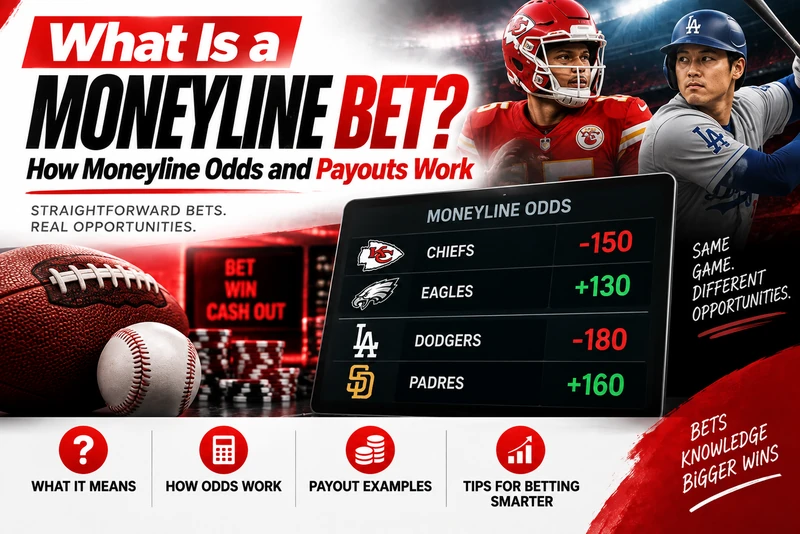
In a moneyline bet, you pick the team or player you think will win. This is the simplest “straight up” bet with no point spread involved. If your side wins the game, your bet wins. That’s the whole idea. The only thing that changes from one matchup to the next is the price, which the odds tell you through a plus or minus number attached to each side.
Because there’s no spread to cover, the moneyline is where most new bettors start. It rewards you for simply being right about who wins. For bookies, it’s one of the easiest bets for your players to understand, which is just one of the reasons that makes it popular in any sportsbook.
How Does a Moneyline Bet Work?
Every moneyline has two sides. The favorite gets a minus sign, and the underdog gets a plus sign. Those numbers do two jobs at once: they tell you who the market expects to win, and they tell you exactly how much you stand to make with either bet.
A minus number (the one with the “-”) is how much you need to risk to win $100. A plus number (the one with the “+”) is how much you win on a $100 risk. Keep in mind: you don’t have to bet in hundreds. That number is just a per-hundred reference point that scales to any stake.
Reading Favorites (the Minus Number)
Say the Chiefs are listed at -150. The minus tells you they’re favored, and the 150 tells you that you’d risk $150 to win $100. Bet $150 on the Chiefs and, if they win, you collect $250 total. That $250 comes from your $150 back to you plus $100 in profit.
So, the bigger the minus number, the heavier the favorite and the less money you win for taking on the same risk. Following this logic, a -400 favorite is a much safer pick on paper, but you’d have to bet $400 to win $100.
Reading Underdogs (the Plus Number)
Now say the opponent is listed as +130. The plus marks them as the underdog, and the 130 tells you a $100 bet wins $130 in profit, for $230 back to you if the underdog actually pulls it off. At the risk of stating the obvious, underdogs pay more because they’re less likely to win. That’s the truth of every moneyline: safer sides pay less, riskier sides pay more.
Moneyline vs. Point Spread: What’s the Difference?
The moneyline asks one question: who wins? The point spread asks a harder one: who wins after a particular margin is applied? That’s a big difference.
On the spread, a favorite has to win by more than a set number of points. An underdog can lose by less than that number and still cover. On the moneyline, none of that matters. A one-point win pays the same as a thirty-point blowout.
That simplicity is part of the appeal of the moneyline. It also shifts the risk into the price rather than the margin.
So, for a big favorite, the spread might be tempting at even money, but the moneyline makes you lay a steep price for the privilege of ignoring the margin.
Of course, many bettors mix both. Many take underdogs on the moneyline and favorites against the spread. If you want the full picture on margins, see our guide on what a point spread is.
When Should You Bet the Moneyline?
The moneyline is the natural choice for betting on underdogs you believe can win outright. Why? Because the plus price rewards you handsomely for a call the market doubts.
The moneyline is also considered “cleaner” in low-scoring sports like baseball, hockey, and soccer. That’s because a single goal or run decides games and point spreads matter less.
It’s less appealing on heavy favorites, where laying -400 or worse ties up a lot of risk for a small return. In those cases, many bettors look to the spread or a parlay instead to get a better payout. The skill in moneyline betting is less about picking winners and more about deciding whether the price is worth it.
How Payouts Are Calculated
For a favorite, divide 100 by the odds and multiply by your stake to get profit. So, a $60 bet at -150 returns $40 profit, because 100 divided by 150 is 0.667, times $60.
For an underdog, divide the odds by 100 and multiply by your stake. A $60 bet at +130 returns $78 profit, because 130 divided by 100 is 1.3, times $60. Add your stake back to either result to get your total return.
Most bettors never do this by hand, because the bet slip shows the payout before you confirm. That said, if you understand it, you can better compare prices and spot when one book is offering a better number than another. That’s a big part of what separates the bettors who do well week after week.
How to Get the Best Price on a Moneyline
The same game rarely carries the identical moneyline at every book. One book might have the Chiefs at -150 while another sits at -140. On a $150 bet, that’s a real gap in what you keep. Over a season of wagers, it separates winning bettors from breaking even. Serious players keep two or three sportsbooks and take the better number every time. This is a good habit to develop, and it’s called “line shopping.”
Of course, timing matters too. Moneylines move as money comes in and as news breaks, so an underdog you like at +130 in the morning might be +115 by kickoff after the public gets the news.
If you’re confident in a dog, grabbing the number early often locks in the better price. On favorites, sometimes waiting pays off if the public inflates the other side. The number you take, not just the pick you make, is a big part of successful long-term results.
A Quick Note for Bookies
If you’re the one booking the action, the moneyline is where your vig hides in the price. The two sides won’t add up to a fair 100 percent. The gap between them is your margin. Setting and moving those numbers as money comes in is how you protect your sportsbook.
Modern pay per head software prices and adjusts moneylines automatically so you’re not doing it by hand. Knowing all there is to know about the bet from the player’s side makes you a sharper bookmaker.
Frequently Asked Questions About Moneyline Bets
What does a moneyline bet mean?
It means betting on which team or player will win the game outright, with no point spread. If your pick wins, your bet wins, regardless of the final margin.
What does +150 mean on a moneyline?
The plus sign marks an underdog, and 150 means a $100 bet would win $150 in profit, returning $250 total. Any stake scales to that ratio.
What does -150 mean on a moneyline?
The minus sign marks a favorite, and 150 means you’d risk $150 to win $100 in profit, returning $250 total if that side wins.
Is the moneyline better than the spread?
Neither is better overall. They just suit different situations. The moneyline is simpler and great for underdogs as well as for low-scoring sports. The spread often gives a better price on heavy favorites.
Can a moneyline bet end in a tie?
In sports that allow draws, like soccer, a tie is usually its own separate outcome (a three-way moneyline). In most US sports with overtime, there’s a winner, so ties are rare and handled by the book’s rules.


