

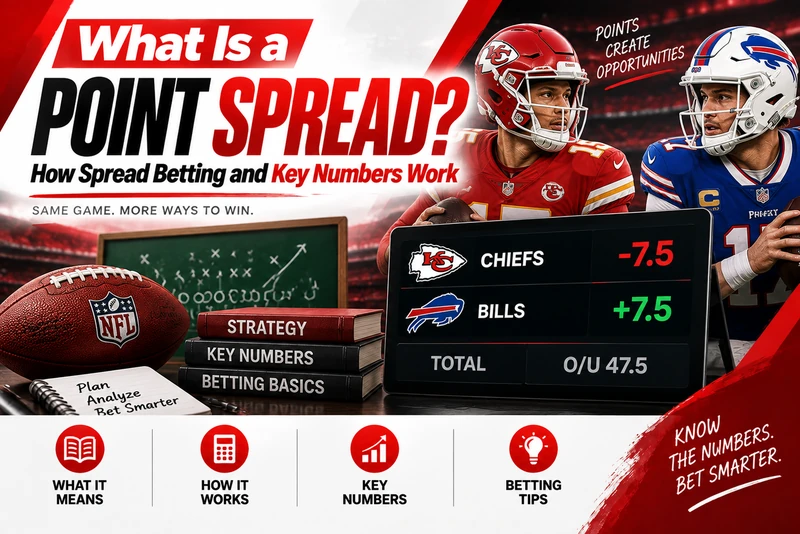
A point spread is a handicap that makes both sides roughly even betting propositions. Instead of just picking who wins, you bet on whether the favorite wins by more than a set number of points or the underdog stays within it.
Instead of starting at “zero,” a point spread will say that one team is “minus” a set number of points/runs/etc. Then, the bettor has the option to choose to “take” or “give” the points, depending on their bet.
By that same token, the favorite “gives” points and the underdog “gets” them, and your bet is graded against that adjusted margin, not the raw final score.
The spread exists because most games have a clear favorite. If you could only bet on who wins, everyone would pile on the better team. By forcing the favorite to win by a margin, the book turns a lopsided matchup into a near coin flip, which is exactly what balanced betting action needs. For bookies, the spread can be both popular and lucrative.
How Does a Point Spread Work?
A spread is written as a number with a plus or minus sign next to each team. The favorite carries a minus, the underdog a plus, and the number is the margin in points.
Say the Cowboys are -6.5 against the Giants at +6.5. The Cowboys are favored by six and a half points. To win if you bet on Dallas, the Cowboys have to win by seven or more. To win a bet on the Giants, the G-Men either have to win outright or lose by six or fewer. That half-point matters quite a bit.
Betting the Favorite (Giving Points)
When you bet the favorite, you’re subtracting points from their final score. Take the Cowboys at -6.5. If they win 27-20, that’s a seven-point margin, which clears the spread, so your bet wins. If they win 24-20, that’s only four points. So, while the Cowboys won the game, they didn’t “cover.” As a result, your spread bet loses even though the Cowboys won. Backing a favorite on the spread means you need them to win by a certain margin, and not just to win.
Betting the Underdog (Getting Points)
When you bet the underdog, you’re adding points to their final score. The Giants at +6.5 cover if they lose by six or fewer, or win outright. Lose 24-20, and those who bet on the Giants win. Why? Because four is inside the six-and-a-half-point cushion. This is why underdog spread bettors can be happy with a loss on the scoreboard. After all, they’re betting the margin and not the winner.
What Does the -110 Next to a Spread Mean?
Look at a spread and you’ll usually see something like -110 attached to both sides. That’s the price, or the vig, and it’s separate from the spread itself. It means you risk $110 to win $100. The extra ten dollars is the book’s built-in margin. Essentially, this is the cost of placing the bet. Standard spreads are priced around -110 on each side, though books nudge that number to balance their action.
Why Half-Points Matter: The Hook
That “.5” you keep seeing is called “the hook.” Basically, it exists to eliminate ties. If a spread were a whole number, say -7, and the favorite won by exactly seven, the bet would “push,” and everyone gets their money back. That’s not what the bookies want.
The half-point removes that possibility, guaranteeing a winner and a loser. The hook is small but mighty: a game landing on 7 is common in the NFL. As a result, -6.5 versus -7.5 can be the difference between cashing and pushing. Sharp bettors hunt for the best side of numbers like 3 and 7 for exactly this reason.
What Is a Push on the Spread?
A push happens when the final margin lands exactly on a whole-number spread. If the Cowboys are -7 and win by exactly seven, the bet pushes and your stake is refunded. In this scenario, there’s no win and no loss.
Pushes only happen on whole-number spreads, which is why so many spreads carry a hook to avoid them. Knowing the difference helps you understand your real risk before you place a bet.
Point Spread vs. Moneyline
The spread and the moneyline are two ways to bet the same game. The moneyline is about who wins outright. In fact, it’s priced so that favorites cost more. The spread is about the margin, priced close to even on both sides.
On a big favorite, the moneyline might make you lay -350, while the spread lets you back the same team at close to even money if you believe they’ll win comfortably. Many bettors choose based on how confident they are in the margin, and not just the winner. Our guide on moneyline bets breaks down that side in full.
Numbers Every Spread Bettor Should Know
Not all spread numbers are created equal, especially in football. Because points come in chunks of 3 (field goals) and 7 (touchdowns), NFL games land on certain final margins far more often than others. The two biggest are 3 and 7, with 10, 6, and 14 close behind. That’s why a spread of -3 is so much more valuable than -3.5.
Something to keep in mind: if you can bet a favorite at -2.5 instead of -3, you win any game decided by exactly a field goal. As you might imagine, that’s one of the most common outcomes in the sport.
The same logic works in reverse for underdogs: getting +3.5 instead of +3 means a three-point loss cashes instead of pushing. These half-points around key numbers are where sharp bettors focus their line shopping. That’s because, over a season, those specific margins come up again and again.
A Quick Note for Bookies
If you’re booking the action, the spread is your primary tool for balancing a game. Set it well and money comes in evenly on both sides, letting the vig do the work. Set it poorly and you take on lopsided risk. As sharp money hits one side, you move the number to nudge action back toward balance.
Always, you want to watch the key numbers closely. After all, a half-point in the wrong spot is expensive. Good pay per head software prices spreads, moves them automatically, and shows your exposure in real time. That’s a major part of what lets a small operator manage and spread risk like a big sportsbook. For more on that, see our guide on how to set betting limits for your players.
Frequently Asked Questions About Point Spreads
What does a point spread mean?
It’s a margin the sportsbook sets so both teams are roughly even bets. You wager on whether the favorite wins by more than the number or the underdog stays within it, rather than on who simply wins.
What does -6.5 mean on a spread?
That team is favored by six and a half points. They must win by seven or more for a bet on them to cover. The half-point guarantees there’s no tie.
What does “cover the spread” mean?
Covering means beating the spread. A favorite covers by winning by more than the number. By that same token, an underdog covers by losing by less than the number or winning outright.
What happens if the score lands exactly on the spread?
On a whole-number spread, that’s a push and your stake is refunded. Spreads with a half-point (the hook) can’t push, because the margin can never land exactly on them.
Why are most spreads priced at -110?
The extra ten dollars on a $100 win is the vig, the sportsbook’s built-in margin. It’s the cost of making the bet and how the book earns its edge on balanced action.


